
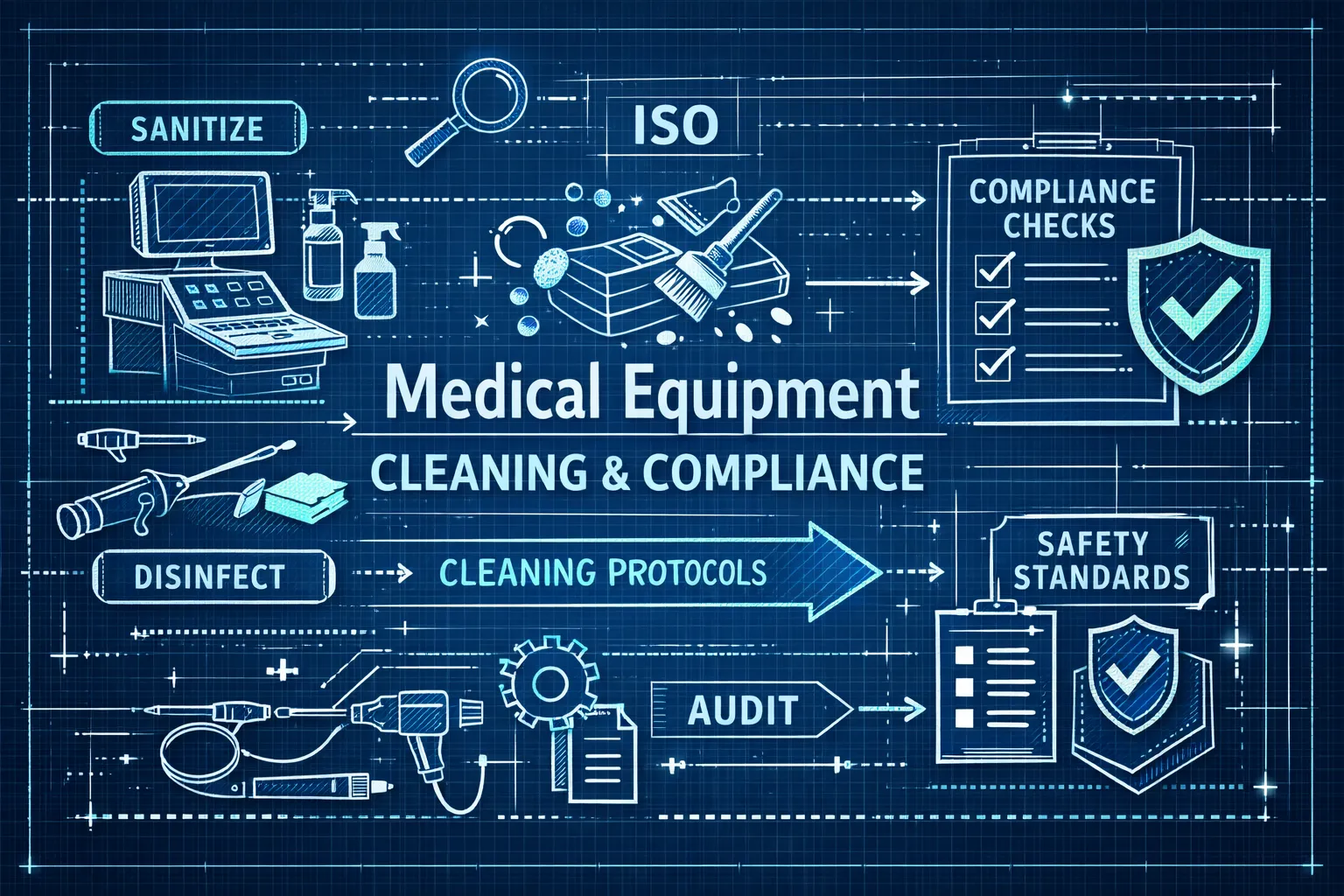
Lab Dynamics' scientists have spent three decades helping laboratories turn protocols into reproducible practice. A single missed rinse or an abbreviated contact time is not a clerical error—it's a predictable path to contamination, patient harm and audit findings under Spaulding‑based policies used by CDC and NHS guidance.
Read this and you will be able to choose the correct decontamination level for any device, follow device‑specific bench steps, pick compatible chemistries with appropriate contact times, and implement audit‑ready SOPs using a downloadable checklist.
1. Choose the Correct Level: Cleaning, Disinfection, Sterilisation
Think of decontamination as three linked actions. Cleaning removes organic matter with detergent and friction; disinfection reduces viable microbes to a defined level; sterilisation achieves complete microbial inactivation (including spores) to an assurance standard.
The Spaulding framework maps risk to action: critical items require sterilisation, semicritical items need high‑level disinfection (HLD) after cleaning, and noncritical items usually need cleaning plus low‑ or intermediate‑level disinfection.
Anchor examples that stick: a stethoscope touching intact skin is noncritical — clean and low‑level wipe; an ultrasound transducer entering the vagina is semicritical — thorough cleaning then HLD; a scalpel or implantable instrument is critical — sterilise.
Two operational rules: always clean first; always follow the device manufacturer's instructions for use (MIFU) and your local risk assessment. NHS policy emphasises risk‑based choices; CDC provides Spaulding clarity.
Quick decision prompt: Is the device entering sterile tissue or mucous membranes? If yes → sterilise or perform validated HLD per MIFU; if not → clean and apply the appropriate level of surface disinfection.
2. Step‑by‑Step Reprocessing for Common Devices
Non‑Critical Reusable Items (Stethoscopes, BP Cuffs, Exam Surfaces)
At point of care wipe gross soil with a detergent wipe. If visibly soiled, perform a detergent wash and rinse. Apply an EPA‑registered or CE‑labelled low/intermediate‑level disinfectant—70% isopropyl/ethyl alcohol works well for stethoscopes; ensure the surface remains wet for the product's stated contact time.
Most important tip: contact time matters—wiping until "dry" is not the same as maintaining wet contact for the disinfectant's labelled time. Lab Dynamics' range of CE‑certified disinfectants includes products with clearly stated contact times to simplify compliance.
Semi‑Critical External Probes (Mucosal Ultrasound Transducers)
Remove gel immediately with enzymatic detergent and a soft wipe. Use manufacturer‑approved probe covers where indicated for intact‑skin scans, but never rely on a cover alone for mucosal contact. After cleaning, perform HLD using a MIFU‑approved chemistry (glutaraldehyde/OPA/peracetic acid or validated H₂O₂ systems) with the required temperature and exposure time. Rinse with sterile or filtered water and dry per IFU.
Most important tip: probe covers reduce risk but do not replace HLD for mucosal or internal uses—treat covered probes as contaminated until cleaned and disinfected. Lab Dynamics supplies PCU probe covers designed for clinical environments alongside ultrasound probe wipes for efficient decontamination workflows.
High‑Risk Internal‑Channel Devices (Flexible Endoscopes)
Endoscope reprocessing is sequential and non‑negotiable. Perform each step exactly as the device IFU requires:
- Point‑of‑use pre‑cleaning: wipe external surfaces, flush channels with enzymatic detergent immediately after use to prevent drying.
- Transport: move in a closed, labelled container with pre‑clean solution to the reprocessing room.
- Leak testing: perform per IFU to detect breaches before immersion.
- Manual cleaning: fully immerse, brush all channels with appropriately sized brushes and flush repeatedly with enzymatic detergent and potable water.
- Visual/borescope inspection: inspect all lumens and surfaces; ATP or borescope checks here provide objective verification.
- HLD or LCS: use an AER when validated; otherwise follow validated manual immersion parameters (approved chemistry, concentration, temperature and contact time).
- Rinse: use sterile or filtered water to remove disinfectant residues.
- Alcohol flush + forced‑air drying: flush channels with 70–90% alcohol then dry completely.
- Storage: hang vertically in ventilated cabinets and tag with reprocessing date and operator.
Most important tip: if manual channel brushing is skipped or inadequate, no HLD will reliably compensate—manual cleaning is the critical control point for endoscopes.
3. Match Chemistry to Material: Disinfectants, Concentrations & Contact Times
Always check MIFU for material compatibility. Plastics, stainless steel and elastomers tolerate many agents, but oxidisers can degrade sensitive rubbers and some polymers.
Practical agent guidance:
- 70% isopropyl or ethyl alcohol — broadly effective for noncritical surfaces and stethoscopes (maintain at least 30 seconds wet time; many wipes specify 1–5 minutes).
- Hydrogen peroxide wipes (≈3%) — compatible with many plastics.
- Sodium hypochlorite — for blood spills use at the correct ppm, rinse and neutralise to protect instruments.
- High‑level disinfectants for semicritical devices include glutaraldehyde (≥2%), peracetic acid and H₂O₂‑based systems; always run to the validated contact time and temperature.
Lab Dynamics' UMONIUM38® range includes CE‑certified formulations designed for compatibility with clinical devices—from surface disinfectants to instrument‑grade solutions—with full SDS and CE declarations available on request.
4. PPE, Safe Handling and Staff Competency
Baseline PPE for manual reprocessing: gloves and eye protection. Escalate to impermeable aprons and face protection for heavy soiling or when using irritant chemistries. Respiratory protection is required if procedures generate aerosols or where the disinfectant label specifies it.
Sequence and handling rules are simple and enforceable: clean → disinfect → rinse (if required) → dry. Work from clean to dirty and top to bottom to avoid cross‑contamination.
Competency framework: training before performing tasks, documented sign‑off, annual refreshers, photographic MIFU aids at the bench and a corrective action pathway for audit failures.
5. SOPs, Traceability and an Audit‑Ready Checklist
Minimum data fields for each reprocessing record should include device ID or serial, operator name, procedure time, point‑of‑use action, cleaning steps completed, disinfectant product name/lot/expiry, concentration and contact time, rinse water source, leak test result, ATP/borescope pass/fail, storage location and final sign‑off.
Structure your audits pragmatically: daily spot checks for process adherence, monthly trend reports with corrective action tracking, an incident log and retention consistent with NHS/CDC expectations.
Implementation tips that scale: build conditional fields in your records, create family SOP templates (stethoscope, probe, endoscope), and define escalation triggers (ATP > threshold, failed leak test → remove from service + investigation).
Lab Dynamics can accelerate this work. We supply CE‑certified disinfectants (including UMONIUM38® formulations), audit‑grade SDS and CE declarations, compatible consumables such as PCU probe covers and Reprocare items, and prefilled checklist templates. Our scientist team can provide product compatibility statements and validation documentation.
6. Validation, Common Failures and a Quick Decision Guide
Validation tools: ATP testing is a rapid audit measure (typical thresholds: <200 RLU for water‑flush ATP tests; ≤100 RLU for sponge/swab methods), borescope inspection for channels, routine leak testing and AER validation logs.
Common failures and remedies:
- Inadequate pre‑cleaning → re‑clean and retrain
- Expired or mis‑diluted disinfectant → discard batch, retrain on mixing SOP and label checks
- Damaged seals/leaks → remove from service and repair
- Incomplete drying → alcohol flush + forced air and revisit drying cabinet performance
Decision guide: critical devices → sterilise; mucous membrane contact → HLD or sterilisation depending on MIFU; intact skin contact → cleaning + low‑level disinfection. When in doubt, follow the MIFU and log any deviation with rationale and corrective action.
Conclusion
Pick the right decontamination level, execute the sequential steps that protect channels and surfaces, validate with ATP/borescope/leak tests and keep meticulous, audit‑ready records. If you need CE‑certified chemistries, SDS/CE declarations or validation support, contact the Lab Dynamics team — our scientists can provide documentation and product compatibility statements to accelerate SOP implementation.